Function LEFT
TABLE OF CONTENTS
- How do I use LEFT?
- Syntax
- Rules for the syntax
- Examples: LEFT function in ERF
- Examples: LEFT function in ECL
How do I use LEFT?
The function LEFT is used to specify the left most bytes of a string. It can be applied to alphanumeric source file fields, column references to alphanumeric columns, alphanumeric lookup fields, and alphanumeric constants. You specify the field name, column reference, or constant, and the desired length.
It can be used in assignments, and in comparisons with the string comparison operators.

Syntax
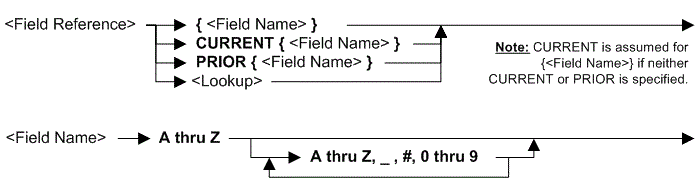
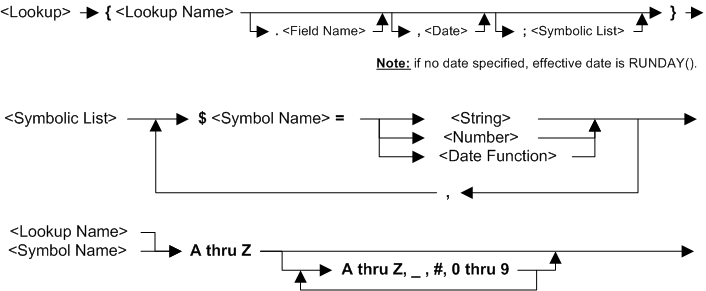
    ►►──LEFT(─┬─<Field Reference>───┬─,─<Length>─)───────────►◄
              ├─<COL.nnn Reference>─┤
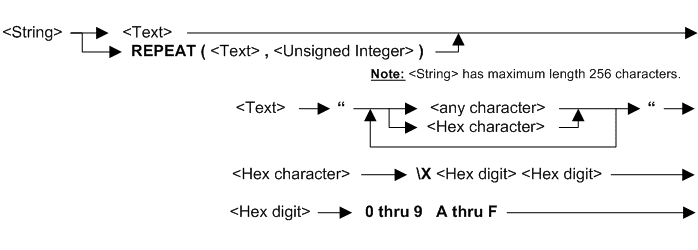
              └─<String>────────────┘

Rules for the syntax
The length is a positive integer and must be equal or less than the field, column or string length.
LEFT can only be used in Extract Record Filter (ERF) and Extract Column Logic (ECL) text.
If used in an Extract Record Filter (ERF), the Column references COL.nnn can not be used.
LEFT can be used in a comparison but only using the string comparison operators BEGINS_WITH, CONTAINS and ENDS_WITH.
See also topic: Rules for all Logic Text
Examples: LEFT function in ERF
| Example logic text | Meaning |
|---|---|
| IF (LEFT({field2},5) CONTAINS “AA”) THEN SELECT ENDIF |
Select only records where field2 has the characters “AA” somewhere in the first five bytes. This example can also be written: SELECTIF(LEFT({field2},5) contains “AA”) |
Examples: LEFT function in ECL
| Example logic text | Meaning |
|---|---|
| COLUMN = LEFT({Cust_Code},4) | Set the current column to the first four bytes of field Cust_Code. |
| COLUMN = LEFT(COL.3,8) | Set the current column to the first eight bytes column 3. This column must be after column 3. |
| IF (LEFT({Cust_Code},8) CONTAINS “AA”) THEN WRITE(SOURCE=VIEW,DEST=EXT=03) ENDIF |
Write to extract 3 those records where the Cust_code contains “AA” anywhere in the first eight characters. |